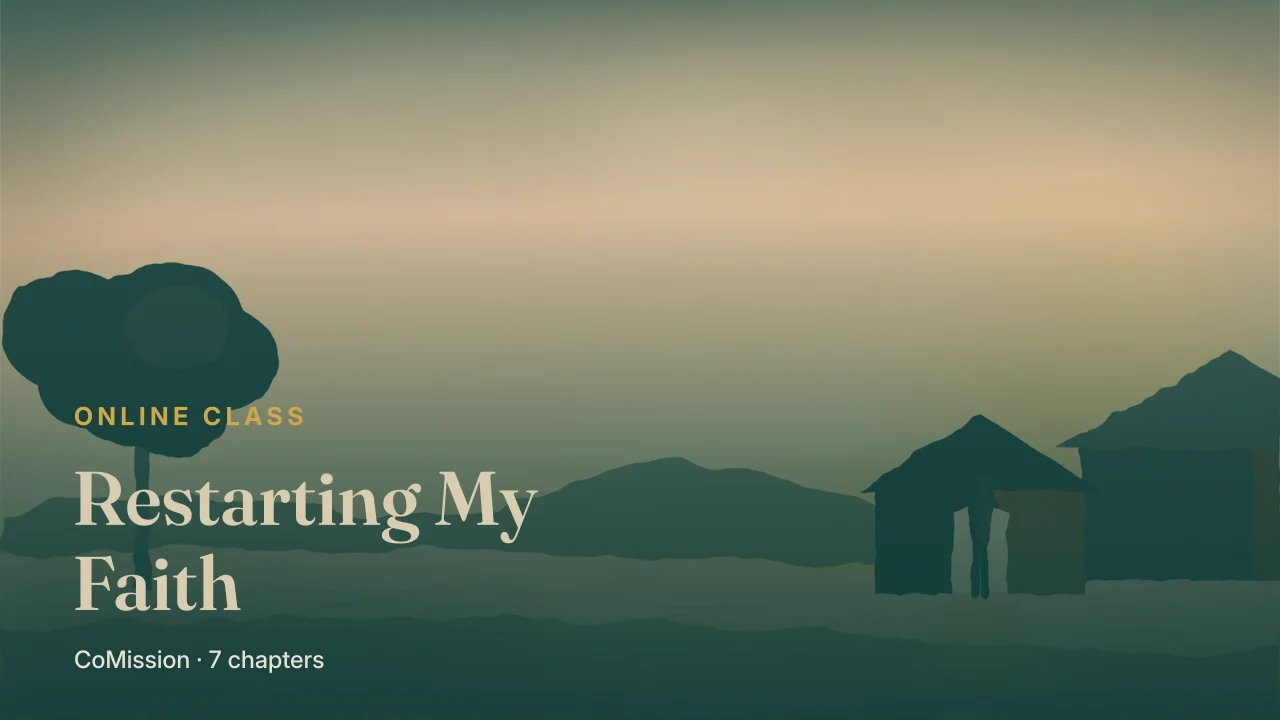
Cover: Restarting My Faith — first light over an open door, a father standing in it looking down the road.

Learning library

Restarting My Faith

For anyone who once walked with God and walked away. You don't fix yourself first. You come home, obey the next thing, and let the Holy Spirit do the changing.

Back to Library

Maybe you drifted, and one day noticed you had not prayed in years. Maybe you went back to something you had promised God you were done with, more than once, and hid. Maybe God went quiet when you needed Him most. Maybe the people who spoke for Him hurt you.

However you got to the far country, this class is for the road home.

It rests on one story Jesus told: a son who took everything, left, lost it all, and came back. Seven chapters walk that story a step at a time, and every one of them says the same three things:

  • You do not fix yourself first. That is what failed. Coming home is where the changing starts, not the reward for having finished it.
  • The way back is obedience. Not a program. One concrete step, with a name and a date, then the next one.
  • The Holy Spirit does the fixing. Your part is to come and to obey. The changing is His.

You can work these chapters alone, but they are written to be walked with one other believer, a mentor who reads the story with you, listens, and asks the questions. If you have someone like that, ask them. If you don’t, start anyway, and pray for one.

  1. The far country — how you got here, named honestly.
  2. Coming to yourself — he didn’t clean up. He got up.
  3. No longer worthy — shame, letting God down, and feeling like a hypocrite.
  4. The Father running — what God is actually like toward the one coming home.
  5. A son, not a servant — robe, ring, sandals, and the Spirit who does the changing.
  6. The elder brother — the people who won’t celebrate, and the one inside you.
  7. Living in the Father’s house — a daily life, and what to do when you fall again.

Each chapter ends the same way: something to obey, and someone to tell.

If you never left, but you are deeply disappointed with the church, Jesus First is written for you.

If you have come home but still find yourself coming to God out of fear, or mostly for what He can give, Love God for Who He Is is written for you.

Print it

Chapters

  1. The far countryHow you got here, named honestly. You can start from where you actually are.
  2. Coming to yourselfHe didn't clean up. He got up.
  3. No longer worthyShame, letting God down, and feeling like a hypocrite. The Father never let him finish the speech.
  4. The Father runningWhat God is actually like toward the one coming home. He was watching the road.
  5. A son, not a servantRobe, ring, sandals, and the Spirit who does the changing. Sons don't earn the house. They live in it.
  6. The elder brotherThe people who won't celebrate, and the one inside you. The party doesn't wait on the elder brother.
  7. Living in the Father's houseA daily life, not a comeback moment, and what to do when you fall again. Come back the same way, every time.

Have questions as you learn?

You don't have to work it out alone, and asking costs nothing. Tell us what the class raised — where to start, what to do next, or the part that didn't make sense — and we'll write back by email.

Leading this class

For Leaders

Printables

Leader book (PDF)Everything in the workbook, plus facilitator notes, timing, and answers.Leader book booklet (11×17)Leader book booklet (A3)Tabloid paper: print double-sided, flip on short edge, fold in half and staple on the spine.A3 paper: print double-sided, flip on short edge, fold in half and staple on the spine.

How to use them

One mentor, one returner

This class is never taught to a group. It is walked by one believer beside one person who once followed Jesus and has been away — for a season or for decades. Everything in the mentor book assumes that shape: two chairs, one story, and seven conversations.

Who should mentor. Someone of the same gender, mature in the faith, and not in a hurry. Maturity here does not mean having never fallen; it means having come back honestly and knowing the Father who runs. A mentor who needs the returner to be fixed by week seven is the wrong mentor for this book.

Where to meet. A semi-public place: a café, a park bench, a table at the back of a quiet restaurant, a porch in view of the street. Private enough to talk honestly, public enough that nobody is ever alone behind a closed door.

No money. Nothing is charged, lent, borrowed or paid in either direction. Buy your own coffee if you must, and let them buy theirs.

What you keep, and what you cannot

Returners will tell you things they have told nobody. Keep it. Nothing goes to a spouse, a pastor, a prayer chain or a Bible study, even as a request for prayer.

There is one limit, and it is fairer to say it early than to discover it together at the worst moment. If you learn that a child or a vulnerable adult is being harmed, or that the person you are walking with intends to hurt themselves or someone else, safety outranks secrecy. Say this plainly in the first session, in ordinary words, so it never feels like a betrayal later.

When to bring in more help

A mentor is not a counselor, and pretending to be one can do real damage. Abuse, thoughts of self-harm, addiction, and trauma all surface in a class about coming home, because they are often part of why people left. When they do, walking with someone includes helping them find people trained for it — a doctor, a counselor, a recovery group, local authorities where someone is in danger — and then continuing to meet. Referral is not handing them off. It is staying beside them while someone else does what you cannot.

How a session runs

Every session has the same shape, and the sameness is a gift: the returner always knows what comes next.

  1. Last week’s “I will”. Ask how it went. If it happened, be glad. If it did not, one question — what got in the way? — then recommit.
  2. Read the passage twice. Once each, aloud if you can.
  3. They retell it. In their own words, with the page closed.
  4. The chapter’s questions. Theirs to answer. Ask, then wait.
  5. A dated “I will”, and who they will tell. A real day and a real name.
  6. Pray. Briefly, by name, in plain words.

The hardest part of the shape is step four. The Bible and the Spirit are the teachers; the mentor asks. If you find yourself explaining what a verse means before they have had a chance to find it, stop and ask a question instead.

The two things that matter most

Two moments decide whether a returner keeps coming. The first is shame. When they say they have let God down, or that they are a hypocrite, do not shrink the sin and do not agree with the sentence. Chapter 3 is built for that moment; give it all the time it needs.

The second is church hurt. When it comes, receive it. Do not defend anyone, explain anyone, or hurry them back to any building. Father first, then family.

Using the two books

The workbook belongs to the returner: a short lead-in for each chapter, the passage, the questions, and room to write. Give it to them at the first session. What they write in it is theirs; never ask to collect it.

The mentor book is this one: the same passage and questions, plus what to listen for, when to speak, when to stay quiet, and a note on every question. Keep it for yourself and have it open when you meet. It was written for one reader, and that reader is you.

This class

7 chapters

For anyone who once walked with God and walked away. You don't fix yourself first. You come home, obey the next thing, and let the Holy Spirit do the changing.

Time needed

Per session
30–45 minutes, one-on-one
In total
Seven sessions, about one a week

Before you lead

Read Luke 15 through several times before the first session, until you can tell the younger son's story without the page. Walk your own road home honestly: if you have ever drifted, hidden, or been disappointed with God, know how you would say so in two sentences. Practice the apology aloud until it sounds like you: "I'm sorry if Christians have ever made you feel judged. That's not how Jesus treated people." Know, before you need it, who you would call for help with abuse, self-harm, addiction or trauma where you live.

What to bring

  • A printed workbook for the person you are walking with
  • This book, for you, and a pen
  • A Bible, or the passage printed, for each of you